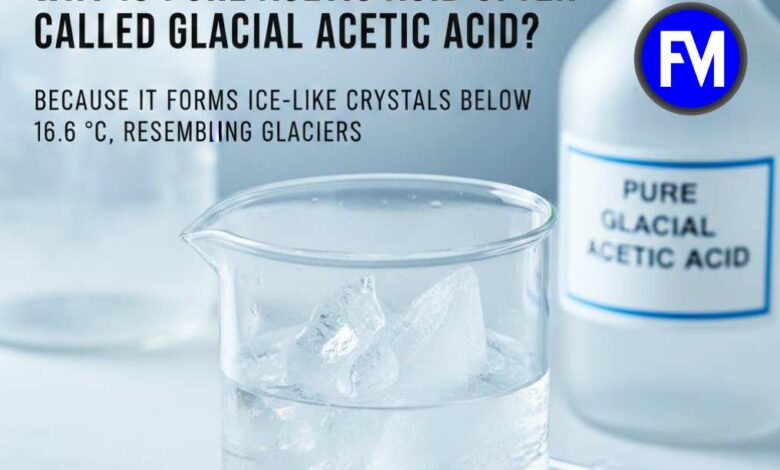
Pure acetic acid, also known as glacial acetic acid, is a powerful and versatile chemical compound with a variety of industrial and laboratory applications. The name “glacial acetic acid” has its roots in the chemical’s unique ability to solidify at temperatures just below room temperature. This article will dive into the reasons why pure acetic acid is often called glacial acetic acid, its physical properties, uses, and the history behind its name. By the end of this piece, you will have a clearer understanding of this fascinating chemical and its importance in various fields.
What Is Glacial Acetic Acid?
Acetic acid (CH₃COOH) is a colorless liquid that is widely known as the main component of vinegar, contributing to its sour taste. However, when acetic acid is highly concentrated, it is referred to as “glacial acetic acid.” This highly concentrated form of acetic acid is nearly 100% pure, making it much stronger than vinegar. One of the most striking characteristics of glacial acetic acid is its ability to freeze into solid crystals at just 16.7°C (62°F), a temperature slightly below room temperature. This feature gives it the unique “glacial” name.
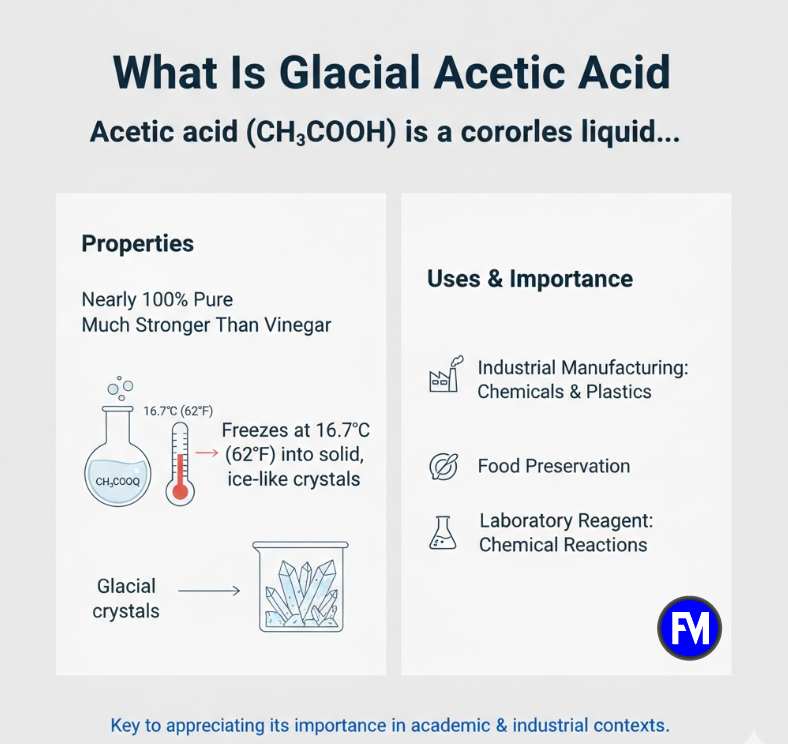
Glacial acetic acid is used in many industries, ranging from the manufacture of chemicals to food preservation. It is also an essential component in laboratories for various chemical reactions. Understanding why pure acetic acid is called glacial acetic acid is key to appreciating its importance in both academic and industrial contexts.
The Origin of the Name “Glacial”
The term “glacial” refers to the characteristic of acetic acid that allows it to freeze and form solid crystals, resembling ice, at a relatively low temperature. The word “glacial” comes from the Latin word glacies, meaning ice, a fitting description of the way acetic acid behaves when it solidifies. This freezing characteristic sets it apart from diluted acetic acid (i.e., vinegar), which remains in liquid form even in cooler temperatures.
The name also has roots in other languages, such as the German word “Eisessig,” which translates to “ice vinegar.” This term further emphasizes the ice-like quality of glacial acetic acid. As a result, the name not only describes its solidification property but also highlights its pure, undiluted state.
Physical Properties of Glacial Acetic Acid
Freezing Point and Solidification
One of the defining characteristics of glacial acetic acid is its freezing point. While most liquids freeze at temperatures well below freezing, glacial acetic acid begins to solidify at 16.7°C (62°F), just below room temperature. This relatively high freezing point is what earns it the “glacial” name.
For comparison, common vinegar, which contains about 5-10% acetic acid and 90-95% water, remains in a liquid state at these temperatures. The presence of water lowers the freezing point of vinegar, preventing it from solidifying. Glacial acetic acid, on the other hand, is anhydrous, meaning it lacks water and can solidify at this higher temperature.
Appearance of Glacial Acetic Acid
When glacial acetic acid solidifies, it forms clear, colorless crystals that resemble ice. These ice-like crystals can be observed when the temperature drops just below 16.7°C, adding to its visual similarity to glaciers or ice.
In its liquid form, glacial acetic acid is a pungent-smelling liquid. The strong, sharp odor is characteristic of acetic acid and is commonly associated with vinegar. However, because of its higher concentration, glacial acetic acid has a much more potent odor, which can be overwhelming in high concentrations.
Purity and Concentration
Glacial acetic acid is essentially pure acetic acid, containing 99-100% acetic acid by weight. In contrast, the acetic acid found in household vinegar is only about 5-10% acetic acid, with the remainder being water. The high concentration of acetic acid in glacial acetic acid makes it highly reactive and capable of participating in various chemical reactions, which is why it is widely used in industrial and laboratory settings.
The term “glacial” also indicates that the substance is anhydrous, meaning it does not contain any water. Water in acetic acid lowers its freezing point and prevents it from forming solid crystals at lower temperatures. As such, pure acetic acid is crucial for various chemical processes that require a water-free environment.
Uses and Applications of Glacial Acetic Acid
Glacial acetic acid plays an essential role in a variety of industrial processes. Here are some key uses:
- Manufacturing of Chemicals: Glacial acetic acid is a key raw material in the production of chemicals such as acetic anhydride, acetate esters, and acetic acid derivatives. These chemicals are used in the production of plastics, fibers, and other industrial products.
- Food Preservation: In the food industry, acetic acid is used as a preservative and to regulate acidity. It is also a key component in the production of vinegar, which is used in food preparation and preservation.
- Pharmaceuticals: Glacial acetic acid is used in the manufacture of certain pharmaceuticals, including aspirin, as well as in medical and laboratory applications.
- Solvent and Reagent: It is used as a solvent in chemical reactions and as a reagent in laboratories for various synthesis reactions.
- Textile Industry: Acetic acid is used in the textile industry for dyeing and printing fabrics, especially in the case of wool and silk.
The Chemistry Behind Glacial Acetic Acid
The chemistry behind glacial acetic acid lies in its chemical structure. Acetic acid is a weak acid with the formula CH₃COOH. In its pure form, acetic acid exists as a colorless liquid, and its molecular structure is composed of a carboxyl group (-COOH) attached to a methyl group (-CH₃). The presence of this carboxyl group gives acetic acid its acidic properties, making it a useful substance in many industrial applications.
When acetic acid is highly concentrated (as in glacial acetic acid), its reactivity increases. This high concentration of acetic acid is responsible for its ability to dissolve a wide range of substances, including metals, and its use as a catalyst in various chemical reactions.
Common Misconceptions about Glacial Acetic Acid
There are several common misconceptions about glacial acetic acid that need clarification:
- It is the same as vinegar: While vinegar contains acetic acid, it is highly diluted with water. Glacial acetic acid is far more concentrated and pure.
- It is safe to handle without precautions: Due to its high acidity and reactivity, glacial acetic acid can be corrosive. It should be handled with caution and proper protective equipment, including gloves and goggles.
- It is always in liquid form: Glacial acetic acid solidifies at temperatures below 16.7°C, so it is not always in liquid form. At room temperature, it is usually a liquid, but in cooler conditions, it can solidify into a crystalline form.
Conclusion: Why Is Pure Acetic Acid Called Glacial Acetic Acid?
In summary, pure acetic acid is called glacial acetic acid because of its ability to solidify into ice-like crystals just below room temperature, resembling a glacier. The name “glacial” highlights its unique freezing property and pure, anhydrous state. With a variety of industrial applications ranging from chemical manufacturing to food preservation, glacial acetic acid plays an important role in many sectors. Understanding its properties and uses can help demystify why it has earned such a distinctive name and how it is utilized in various fields.
For More Updates Visit: Fortune Magazine