Manufacturing downtime costs industrial operations between $22,000 and $50,000 per hour, making equipment reliability a critical factor in controller selection. When brushless motor controllers fail in automated production lines, conveyor systems, or precision machinery, the cascading effects extend far beyond simple component replacement. Understanding the fundamental differences between industrial-grade and hobbyist motor controllers becomes essential for maintaining operational consistency and preventing costly interruptions.
The distinction between these controller categories goes beyond price points or marketing labels. Industrial environments demand controllers that withstand temperature fluctuations, electrical noise, vibration, and extended operating cycles while maintaining precise performance standards. These operational requirements drive specific design choices that separate professional-grade hardware from consumer-oriented alternatives.
Voltage and Current Handling Capacity
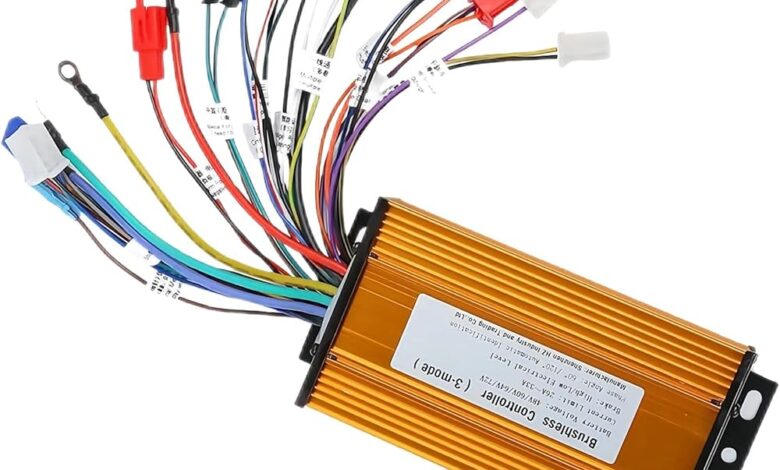
Industrial brushless motor controllers operate within substantially higher voltage and current ranges compared to hobbyist alternatives. Professional applications frequently require controllers capable of handling 200-600 volt DC systems with current capacities exceeding 50 amperes continuously. This Industrial Brushless Motor Controller overview demonstrates the technical specifications necessary for demanding operational environments.
The power handling requirements stem from the motors themselves. Industrial brushless motors typically range from several kilowatts to hundreds of kilowatts, demanding controllers with robust power stages and thermal management systems. Hobbyist controllers, designed for drone motors or small robotics projects, rarely exceed 12-48 volts and handle current loads below 20 amperes.
Power Stage Design Differences
Industrial controllers incorporate power stages built with discrete MOSFET or IGBT devices selected for high current density and thermal performance. These components undergo rigorous testing for avalanche energy handling and safe operating area compliance. The power stage design includes multiple parallel devices to distribute thermal stress and provide redundancy during peak load conditions.
Hobbyist controllers typically use integrated power stage modules or lower-grade switching devices optimized for cost rather than reliability. The thermal management in these units relies on basic heatsinking without sophisticated thermal monitoring or protection systems.
Surge Protection and Fault Handling
Professional controllers implement comprehensive protection schemes including overcurrent limiting, overvoltage clamping, and thermal shutdown with automatic recovery. These protection systems operate independently of the main control processor to ensure reliable operation even during software failures or communication interruptions.
The protection circuitry in industrial units includes hardware-based current sensing with microsecond response times and robust gate drive isolation to prevent cross-conduction failures. This level of protection prevents single-point failures from cascading into complete system shutdowns.
Environmental Operating Specifications
Temperature range specifications reveal significant differences between industrial and hobbyist motor controllers. Industrial units typically operate across -20°C to +60°C ambient ranges while maintaining full performance specifications. Extended temperature variants handle -40°C to +85°C for outdoor installations or harsh manufacturing environments.
The temperature performance extends beyond simple operation to include storage ratings, thermal cycling endurance, and humidity resistance. Industrial controllers undergo testing per IEC standards for temperature cycling, thermal shock, and damp heat exposure to ensure consistent performance across varied environmental conditions.
Vibration and Shock Resistance
Manufacturing environments subject motor controllers to continuous vibration from nearby machinery, conveyors, and production equipment. Industrial controllers incorporate mechanical design features including robust PCB mounting, potted electronics, and vibration-dampened connectors to withstand these conditions without degradation.
The testing standards for industrial units include sinusoidal vibration testing across frequency ranges from 10-2000 Hz with acceleration levels up to 20g. Shock testing verifies survival during transportation, installation, and operational impacts that would disable hobbyist-grade hardware.
Ingress Protection Ratings
Dust and moisture protection becomes critical in industrial applications where controllers may be exposed to coolant spray, cleaning procedures, or contaminated air. Professional controllers achieve IP65 or higher ratings through sealed enclosures, gasketted connectors, and conformal coating protection on circuit boards.
The enclosure design includes features like drainage channels, cable entry systems with strain relief, and ventilation paths that maintain protection while allowing thermal management. These design elements prevent the gradual degradation common in unprotected electronics exposed to industrial environments.
Control Algorithm Sophistication
The control algorithms in industrial brushless motor controllers incorporate advanced techniques for precise speed and torque regulation under varying load conditions. Field-oriented control (FOC) implementations in professional units include sophisticated parameter estimation, adaptive gain scheduling, and disturbance compensation to maintain performance across operating ranges.
These algorithms operate at high computational rates, typically executing control loops at 10-20 kHz to ensure smooth operation and rapid response to load changes. The mathematical precision includes 32-bit floating-point calculations for position feedback integration and velocity estimation filtering.
Sensor Integration and Feedback Processing
Industrial motor controllers support multiple feedback sensor types including resolvers, absolute encoders, and incremental encoders with line counts exceeding 1 million pulses per revolution. The sensor interface circuitry provides differential signaling, fault detection, and signal conditioning to maintain accuracy in electrically noisy environments.
Advanced controllers implement sensor fusion techniques that combine multiple feedback sources for improved reliability and accuracy. This includes comparing encoder feedback with motor back-EMF sensing to detect sensor failures or mechanical coupling problems before they affect system performance.
Load Adaptation and Efficiency Optimization
Professional controllers continuously monitor motor performance parameters and adjust control algorithms to optimize efficiency and reduce thermal stress. This includes automatic timing adjustment, current vector optimization, and power factor correction that adapts to changing load conditions without manual intervention.
The efficiency optimization extends to regenerative braking implementation, where kinetic energy from decelerating loads feeds back to the power supply system. This capability requires sophisticated power stage design and control coordination that exceeds the complexity of basic hobbyist controllers.
Communication and Integration Capabilities
Industrial automation systems require motor controllers that integrate seamlessly with supervisory control systems through standardized communication protocols. Professional controllers support industrial fieldbus networks including EtherCAT, Profinet, and CANopen with guaranteed real-time performance and deterministic response characteristics.
The communication implementation includes features like distributed clock synchronization for coordinated multi-axis motion, emergency stop handling through safety communication channels, and diagnostic data reporting for predictive maintenance systems. According to the Industrial Ethernet standards, these protocols ensure reliable data exchange in mission-critical applications.
Safety Integration and Functional Safety
Professional motor controllers incorporate safety functions that comply with IEC 61508 functional safety standards for industrial machinery. These safety systems include hardware-based monitoring circuits, safe torque-off functionality, and safety-rated communication channels that operate independently of the main control processor.
The safety implementation includes features like dual-channel position monitoring, safe speed monitoring, and safety-rated encoder feedback processing. These functions enable compliance with machinery safety standards while maintaining operational flexibility for complex automation systems.
Diagnostic and Maintenance Features
Industrial controllers provide comprehensive diagnostic capabilities including real-time parameter monitoring, historical data logging, and predictive maintenance alerts. The diagnostic system tracks component aging indicators, thermal cycling counts, and performance drift patterns to enable proactive maintenance scheduling.
Advanced diagnostic features include spectrum analysis of motor current signatures for bearing condition monitoring, insulation resistance testing capabilities, and automatic calibration verification procedures. These features reduce unplanned downtime by identifying developing problems before they cause failures.
Power Supply and Electrical Isolation
The power supply design in industrial motor controllers addresses the electrical noise and power quality issues common in manufacturing environments. Professional units include input filtering, power factor correction, and ride-through capabilities that maintain operation during brief power interruptions or voltage sags.
Electrical isolation between control circuits and power circuits exceeds basic safety requirements to provide noise immunity and prevent ground loop problems in large industrial installations. This isolation typically includes reinforced insulation barriers tested to several kilovolts and common-mode filtering to attenuate high-frequency interference.
Electromagnetic Compatibility
Industrial controllers undergo extensive EMC testing to ensure compliance with emission limits and immunity requirements for industrial environments. The design includes features like spread-spectrum switching, output filtering, and shielded enclosures to minimize electromagnetic interference while maintaining immunity to external disturbances.
The EMC design considerations extend to cable routing recommendations, grounding specifications, and installation guidelines that ensure proper system-level performance. These factors become critical in installations with multiple controllers, communication networks, and sensitive instrumentation.
Conclusion
The specifications that distinguish industrial brushless motor controllers from hobbyist alternatives reflect the operational demands of professional manufacturing and automation environments. Voltage handling capacity, environmental resilience, control algorithm sophistication, communication capabilities, and power supply design all contribute to the reliability and performance requirements of industrial applications. Understanding these differences enables informed decisions when selecting motor control hardware for mission-critical applications where downtime costs and operational reliability significantly impact business outcomes. The investment in industrial-grade controllers proves justified when measured against the potential costs of equipment failures, production interruptions, and maintenance complications associated with inadequate hardware specifications.