
Why 100G Networking Is Not Only About Optics
When people talk about 100G networking, the discussion almost always centers on optical modules, fiber types, and transmission distances. That focus makes sense for long-haul or inter-building links, but it hides an important reality: most 100G ports in real data centers are not used for long distances at all.
Inside racks and between adjacent racks, link distances are short, often measured in meters rather than kilometers. In these environments, 100G DAC (Direct Attach Copper) cables are not a compromise or a temporary solution. They are often the most logical and efficient choice.
What a 100G DAC Really Is, in Practical Terms
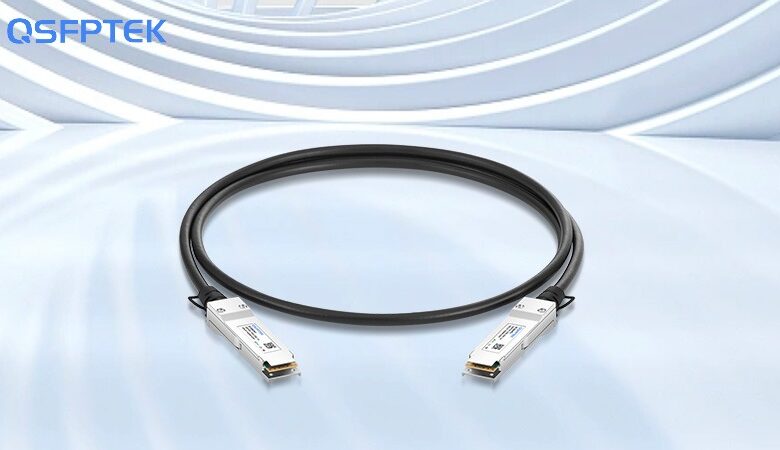
A 100G DAC cable integrates copper conductors and QSFP28 connectors into a single, factory-terminated assembly. Unlike optical modules, there are no lasers, photodiodes, or optical signal conversions involved. The signal remains electrical from one end to the other.
From a user perspective, a 100G DAC cable behaves like a fixed-length patch cable. You plug it into two QSFP28 ports, and the link comes up. There is no need to match optics, calculate optical budgets, or worry about wavelength compatibility.
Why DAC Makes Sense for Short Distances
For very short links, optical transmission does not offer meaningful advantages. Copper can handle 100G reliably over a few meters with excellent signal integrity. Using optics in these cases adds unnecessary cost, power consumption, and complexity.
DAC cables eliminate the optical-to-electrical conversion process entirely. This reduces latency, lowers power draw, and removes multiple potential points of failure. In large-scale deployments, these small advantages accumulate into significant operational benefits.
Latency and Power: Small Differences That Matter at Scale
Latency differences between DAC and optics are measured in fractions of microseconds, but in certain environments, those fractions matter. High-frequency trading platforms, storage clusters, and tightly coupled compute fabrics often value the lowest possible latency.
Power consumption is another area where DAC quietly excels. Passive DAC cables consume essentially no power. Even active DAC variants consume far less than optical transceivers. In dense 100G environments, this can noticeably reduce overall rack power usage and heat generation.
Passive vs Active 100G DAC Cables
Passive DAC cables are the simplest and most common option. They rely entirely on the signal strength of the host ports and typically support distances up to 2–3 meters. They are inexpensive, extremely reliable, and widely interoperable.
Active DAC cables include signal conditioning electronics inside the connectors. This allows them to support slightly longer distances, usually up to 7–10 meters. The trade-off is higher cost and minimal power consumption, but still far less than optical alternatives.
Choosing between passive and active DAC is usually a physical layout decision, not a performance one.
Common Deployment Scenarios for 100G DAC
DAC cables are most commonly used in top-of-rack to leaf switch connections, server-to-switch links, and GPU or storage interconnects. In these scenarios, equipment is physically close, and cable lengths are predictable.
Because DAC cables are pre-terminated, deployment is fast. There is no fiber polishing, no connector inspection, and no specialized testing equipment required. This simplicity is particularly valuable during large-scale rollouts.
Operational Simplicity and Reliability
From an operational standpoint, DAC cables are refreshingly boring. There are no optical parameters to tune, no signal levels to monitor, and no cleaning procedures to maintain. Once installed, they tend to stay in place until hardware is replaced.
Failures do occur, but they are rare and usually obvious. A damaged cable or connector is easy to identify and replace. This reduces troubleshooting time and operational stress, especially in high-density environments.
Cable Management and Physical Considerations
One drawback of DAC is cable thickness. Copper cables are bulkier than fiber, which can impact airflow and cable management if not planned carefully. However, with proper routing and labeling, these issues are manageable.
In return, operators gain robustness. DAC cables are generally less sensitive to bending, dust, and connector contamination than optical fibers.
Interoperability and Vendor Flexibility
Most 100G DAC cables are built to industry standards and work across a wide range of switches and network interface cards. While some vendors apply coding or compatibility checks, many environments successfully mix DAC cables and hardware from different sources.
This flexibility makes DAC attractive for cost-conscious operators who want to avoid being locked into a single vendor ecosystem.
Why 100G DAC Is Not Going Away
As networks move toward 200G and 400G, some assume DAC will fade away. In reality, higher speeds often increase short-range port density, which strengthens the case for DAC rather than weakening it.
As long as equipment remains physically close, copper will remain efficient. For short distances, the simplest solution is often the best one.
Conclusion
100G DAC cables play a critical but often overlooked role in modern networks. They deliver reliable, low-latency, low-power connectivity where it matters most — inside racks and across short distances. While optical modules dominate long-reach discussions, DAC quietly carries a large share of real-world 100G traffic.
For networks that value efficiency, simplicity, and operational stability, 100G DAC is not just an option. It is a foundation.