
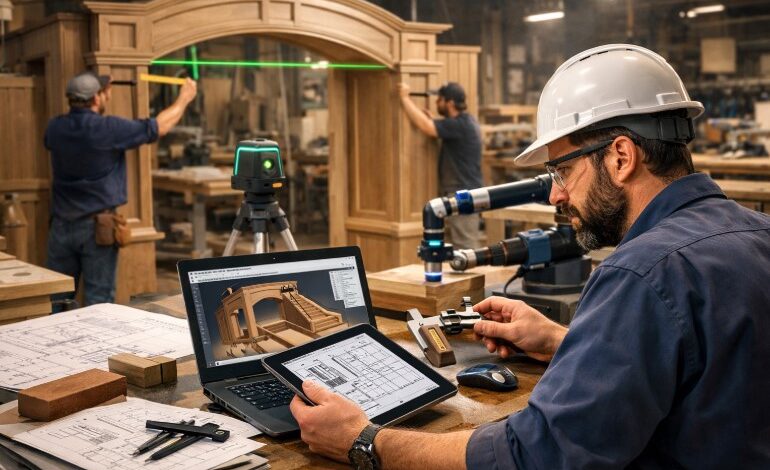
Custom woodwork sits at the intersection of design creativity and structural precision. From bespoke cabinetry and luxury interiors to complex commercial fit-outs, even a few millimeters of error can lead to costly rework, installation delays, or long-term performance issues.
This is where millwork engineers play a critical role.
In today’s fast-evolving construction and interior design landscape particularly across the USA and UK millwork engineers are no longer just drafting support professionals. They are problem solvers, technical strategists, and quality guardians who ensure every custom woodwork component fits, functions, and performs exactly as intended.
This guide explores how millwork engineers ensure structural accuracy in custom woodwork projects, the tools and processes they rely on, current industry trends, and the opportunities shaping the future of custom millwork drafting.
Why Is Structural Accuracy So Critical in Custom Millwork?
Structural accuracy is not just about aesthetics it directly affects safety, durability, and installation efficiency.
In custom millwork projects, components must:
- Align with architectural and structural drawings
- Accommodate site tolerances and material behavior
- Integrate seamlessly with MEP and finishes
- Meet regional building codes and standards
According to Autodesk’s construction industry insights, nearly 30% of construction rework costs are caused by inaccurate drawings and coordination gaps, making precise drafting a business necessity rather than a luxury. (Source: Autodesk Construction Cloud Industry Report)
This challenge is especially pronounced in bespoke woodwork, where no two projects are identical.
Who Are Millwork Engineers and What Do They Actually Do?
Millwork engineers specialize in translating architectural concepts into technically accurate, build-ready shop drawings for custom wood products.
Their responsibilities typically include:
- Interpreting architectural and interior design drawings
- Developing detailed shop drawings with dimensions and tolerances
- Coordinating with architects, contractors, and fabricators
- Selecting appropriate materials and joinery methods
- Ensuring compliance with UK, US, and international standards
A millwork drafter, working under or alongside millwork engineers, focuses on creating precise CAD drawings, while engineers validate structural integrity, load considerations, and constructability.
Together, they bridge the gap between design intent and fabrication reality.
How Do Millwork Engineers Achieve Structural Accuracy from Concept to Installation?
1. How Do They Interpret Design Intent Correctly?
Every structurally accurate millwork project starts with clear interpretation.
Millwork engineers review:
- Architectural plans
- Interior elevations
- RCPs and sections
- Design specifications and finish schedules
Rather than copying designs blindly, they analyze:
- Load paths and support requirements
- Connection points with walls, floors, and ceilings
- Tolerance allowances for on-site conditions
This analytical approach ensures that artistic concepts remain structurally feasible.
2. How Does Custom Millwork Drafting Reduce Errors?
Custom millwork drafting transforms design concepts into highly detailed technical drawings that fabricators and installers can trust.
These drawings typically include:
- Exact dimensions and scale references
- Material thickness and grain orientation
- Joinery and fastening details
- Hardware specifications
- Section cuts and exploded views
According to McKinsey & Company, digital drafting and modeling can reduce project errors by up to 45% when implemented consistently across design and fabrication teams. (Source: McKinsey – Digital Construction Productivity)
For millwork engineers, precision drafting is the first line of defense against structural inaccuracies.
3. Why Is CAD Technology Essential for Structural Accuracy?
Modern millwork drafting services rely heavily on advanced CAD platforms such as AutoCAD, SolidWorks, and BIM-enabled tools.
CAD technology allows millwork engineers to:
- Maintain consistent dimensional accuracy
- Instantly update revisions across all views
- Detect clashes before fabrication
- Create parametric components for repeatability
In the UK and USA, the adoption of BIM Level 2 and higher has further improved coordination between millwork and other trades. (Source: UK Government BIM Strategy)
4. How Do Millwork Engineers Account for Material Behavior?
Wood is a living material that expands, contracts, and reacts to environmental conditions.
Experienced millwork engineers factor in:
- Moisture content and humidity changes
- Wood movement across grains
- Load-bearing limits of different species
- Fire-rating and durability requirements
Ignoring these variables can compromise structural accuracy over time, even if the initial installation appears perfect.
This is why technical knowledge is just as important as drafting skill.
5. How Is Collaboration Improving Accuracy in Millwork Projects?
Today’s millwork engineers work within collaborative digital ecosystems.
They coordinate closely with:
- Architects for design intent clarification
- Structural engineers for load verification
- Interior designers for finish alignment
- Fabricators for manufacturability feedback
Cloud-based platforms allow real-time updates, reducing version conflicts and miscommunication.
According to Dodge Data & Analytics, collaborative project delivery methods can improve overall construction accuracy by 20–25%. (Source: Dodge Data & Analytics SmartMarket Report)
What Role Does Quality Control Play in Millwork Engineering?
How Do Engineers Validate Accuracy Before Fabrication?
Before drawings are released for production, millwork engineers conduct multiple quality checks:
- Cross-verifying dimensions against architectural plans
- Reviewing tolerance stacks
- Confirming hardware compatibility
- Checking code compliance
Many teams also use peer reviews and checklists to eliminate human error.
This rigorous validation process is a key reason why professional millwork drafting services outperform generic drafting support.
What Are the Latest Trends Affecting Millwork Structural Accuracy?
1. Increased Use of BIM for Millwork
BIM integration enables millwork engineers to model components in a shared 3D environment, improving clash detection and spatial accuracy.
2. Automation and Parametric Design
Parametric CAD tools allow engineers to create scalable components with built-in constraints, reducing manual errors.
3. Offsite Fabrication Growth
With modular and offsite construction gaining traction in the UK and USA, millwork must arrive ready-to-install, making accuracy non-negotiable.
4. Sustainable Material Compliance
Engineers now factor in FSC-certified materials, fire ratings, and sustainability metrics during drafting.
What Challenges Do Millwork Engineers Face Today?
Despite technological advances, millwork engineers still face challenges such as:
- Incomplete or conflicting design information
- Tight project timelines
- Frequent design changes
- Coordination gaps across international teams
However, these challenges also create opportunities for firms that invest in skilled engineers, robust drafting workflows, and advanced CAD tools.
What Opportunities Exist in the Millwork Drafting Industry?
The global custom millwork market continues to grow, driven by:
- Luxury residential demand
- Commercial interior upgrades
- Hospitality and retail expansion
As demand rises, businesses increasingly seek specialized millwork engineers and millwork drafters who can ensure structural accuracy without slowing down delivery.
This makes professional drafting support a strategic asset rather than a cost center.
How Do Accurate Millwork Drawings Benefit Business Owners and Decision-Makers?
For business owners and project stakeholders, structurally accurate millwork means:
- Fewer site issues
- Faster installations
- Lower rework costs
- Improved client satisfaction
- Stronger project margins
Accuracy directly translates into predictability and predictability builds trust.
Final Thoughts:
In a world of increasingly complex designs and tighter delivery schedules, millwork engineers are the unsung heroes of custom woodwork projects.
By combining technical expertise, advanced CAD tools, and collaborative workflows, they ensure that custom millwork is not only beautiful but structurally sound, code-compliant, and ready for real-world use.
For organizations seeking dependable millwork drafting services, partnering with experienced engineering teams such as a leading UK-based CAD design company can make a measurable difference in quality, efficiency, and long-term success.
FAQs
What do millwork engineers do in custom woodwork projects?
Answer:
Millwork engineers ensure structural accuracy in custom woodwork projects by converting design concepts into precise shop drawings. They validate dimensions, materials, joinery, and load considerations to ensure woodwork components are safe, durable, and install-ready.
How do millwork engineers ensure structural accuracy?
Answer:
Millwork engineers ensure accuracy by using advanced CAD software, detailed custom millwork drafting, tolerance analysis, material behavior evaluation, and multi-stage quality checks before fabrication and installation.
What is custom millwork drafting and why is it important?
Answer:
Custom millwork drafting involves creating detailed technical drawings for bespoke woodwork components. It is important because it minimizes fabrication errors, improves installation efficiency, and ensures compliance with building standards in the UK and USA.
What software do millwork engineers use for accurate drafting?
Answer:
Millwork engineers commonly use AutoCAD, SolidWorks, and BIM-enabled platforms to create precise millwork drawings. These tools help detect clashes, manage revisions, and maintain dimensional accuracy throughout the project lifecycle.
How do millwork drafting services reduce construction rework?
Answer:
Professional millwork drafting services reduce rework by providing fabrication-ready drawings with exact dimensions, clear joinery details, and accurate material specifications, preventing costly on-site modifications.
What is the difference between a millwork engineer and a millwork drafter?
Answer:
A millwork engineer focuses on structural integrity, material performance, and compliance, while a millwork drafter prepares detailed CAD drawings based on engineering guidance and design intent.
Why is structural accuracy critical in custom millwork projects?
Answer:
Structural accuracy ensures proper fit, safety, durability, and visual alignment. Even small dimensional errors can lead to installation delays, material waste, and long-term performance issues in custom woodwork.
How do millwork engineers handle material movement in wood?
Answer:
Millwork engineers account for wood expansion and contraction by analyzing grain direction, moisture content, and environmental conditions, ensuring long-term structural stability in custom woodwork installations.
Are millwork drafting services compliant with UK and US standards?
Answer:
Yes, professional millwork drafting services align with UK and US building regulations, fire safety standards, and material compliance requirements, ensuring drawings are suitable for regional approval and fabrication.
How does BIM improve accuracy in millwork engineering?
Answer:
BIM allows millwork engineers to work in a coordinated 3D environment, improving clash detection, spatial coordination, and collaboration with architects and contractors, leading to higher structural accuracy.
When should businesses outsource millwork drafting services?
Answer:
Businesses often outsource millwork drafting services when handling complex custom projects, tight timelines, or international builds requiring high accuracy and compliance with global standards.