
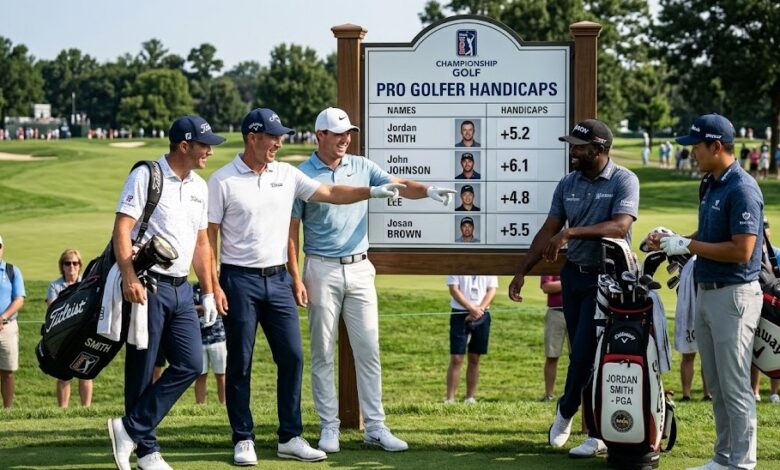
In professional golf, the handicap system works very differently compared to amateur golf, where players are assigned a numeric index based on their average performance. At the elite level, most tour professionals do not officially carry handicaps because their performance is already measured through tournament scoring, leaderboards, and statistical rankings. Instead of relying on a handicap index, professionals are judged directly by how many strokes under or over par they perform in competitive rounds against the strongest fields in the world. However, analysts often estimate pro golfer handicaps to better understand how much better professionals are compared to scratch-level players, and these estimates usually place them in the “plus handicap” category, meaning they consistently outperform par rather than simply matching it.
Average Pro Golfer Handicaps on the PGA Tour
The average pro golfer handicaps on the PGA Tour are not officially recorded in the same way amateur handicaps are, but performance analysis gives a very clear picture of where professionals stand. Most PGA Tour players are effectively operating at an estimated handicap range of around +4 to +6, meaning they are expected to shoot several strokes under par on even difficult courses. This level of consistency is what separates touring professionals from elite amateurs, as pros maintain extremely low scoring averages across varied course conditions, pressure situations, and international events.
What makes this average even more impressive is the level of competition on the PGA Tour. Players are not just competing against the course but also against the best golfers in the world, where small differences in putting, driving accuracy, and short game performance can determine rankings. Because of this, even a fraction of a stroke improvement can significantly impact a player’s standing. This is why discussions around pro golfer handicaps often emphasize that professionals are not just scratch golfers—they are consistently several shots better than par over the long term, which highlights the extreme skill gap between amateurs and tour-level athletes.
Scratch vs Plus Handicap: The Real Difference
The difference between a scratch golfer and players with pro golfer handicaps is one of the most important comparisons in understanding golf performance levels. A scratch golfer has a handicap of 0, meaning they are expected to shoot around par on a good day, with occasional rounds slightly above or below. In contrast, professional golfers are considered “plus handicap” players, meaning they regularly shoot under par. This gap may seem small on paper, but in competitive golf, even one or two strokes per round can completely change outcomes in tournaments.
To put it into perspective, a scratch golfer might shoot around 72 on a standard par-72 course, while a professional golfer with a +5 handicap is expected to shoot around 67 on average. Over four rounds of tournament play, this difference becomes massive, often separating leaders from the rest of the field. The key reason behind this gap is not just talent but consistency—pros rarely make repeated mistakes, and their recovery shots, putting accuracy, and course management are significantly more refined than even the best amateur players.
Factors That Influence Pro-Level Performance
Several important factors shape pro golfer handicaps, and they go far beyond simple swing mechanics. One of the biggest influences is consistency under pressure. Professional golfers are trained to perform in high-stakes environments where a single missed putt or a slight miscalculation can change tournament rankings. Unlike amateurs, pros maintain a high level of mental discipline, which allows them to repeat strong performances across different courses and weather conditions. This consistency is a major reason why their estimated handicaps remain in the plus range.
Another critical factor is technical precision combined with strategic course management. Professional golfers do not simply rely on power; they carefully analyze every shot, from club selection to wind conditions and green speed. Their ability to minimize mistakes and recover from difficult situations keeps their scores consistently low. Physical fitness, advanced training routines, and access to coaching teams also play a major role in shaping pro golfer handicaps, ensuring that every aspect of their game is optimized for peak performance.
Famous Golfers and Their Estimated Handicaps
When discussing pro golfer handicaps, it becomes even more interesting to look at famous players and how their performance translates into estimated handicap levels. While these players do not officially carry handicaps, analysts often calculate what their index would be based on scoring averages and dominance in professional tournaments. For example, top-tier PGA Tour players are commonly estimated around +5 to +7, reflecting their ability to consistently shoot well under par across different courses and conditions.
Legendary golfers like Tiger Woods during his peak years or modern stars such as Rory McIlroy are often considered extreme examples of plus-handicap players. Their scoring ability, especially in major championships, shows a level of control and consistency far beyond even elite amateurs. What stands out most is not just their lowest rounds but their ability to avoid high scores, which keeps their averages extremely low. This is a key reason why pro golfer handicaps for elite names are often described as “off the charts” compared to standard handicap systems used in amateur golf.
Why Professional Golfers Don’t Officially Use Handicaps
One of the most misunderstood aspects of pro golfer handicaps is why professional golfers do not officially maintain a handicap index like amateur players. The main reason is that the handicap system is designed to level the playing field between golfers of different abilities, allowing fair competition in local or amateur events. Professional golfers, however, compete in structured tournaments where all players are already at the highest level, so there is no need for adjustment or equalization of scores.
Instead of handicaps, professionals are evaluated through scoring averages, world rankings, and performance statistics across tournaments. Every shot is recorded and analyzed in detail, making their performance measurable in a far more precise way than a handicap index could provide. Additionally, since professionals often play courses set up specifically for elite competition—with tougher pin positions, faster greens, and longer yardages—the traditional handicap system would not accurately reflect their true ability. This is why discussions about pro golfer handicaps are usually theoretical rather than official.
What Amateur Golfers Can Learn from Pros
Even though pro golfer handicaps represent an elite level of performance, amateur golfers can still learn a great deal from how professionals approach the game. One of the biggest lessons is consistency over power. Many amateurs focus on hitting long drives, but professionals prioritize accuracy, course management, and avoiding costly mistakes. This mindset helps them maintain low scores even on difficult courses, showing that smart decision-making often matters more than raw strength.
Another important takeaway is mental discipline. Professional golfers treat every shot with the same level of focus, whether it is a long drive or a short putt. They also recover quickly from mistakes instead of letting one bad shot affect the rest of the round. Amateurs who adopt this approach often see immediate improvement in their scores. Understanding pro golfer handicaps helps highlight that reaching a high level in golf is not just about talent, but about building habits that support long-term consistency and control under pressure.
Conclusion
The idea of pro golfer handicaps gives a fascinating insight into just how far professional golfers are from even the best amateur players. While scratch golfers are considered highly skilled, professionals operate in a completely different range, often estimated between +4 and +6 handicaps, meaning they consistently shoot several strokes under par. This level of performance is not just about talent but also about discipline, strategy, and the ability to execute under intense pressure.
Understanding how professionals perform helps put the game into perspective for everyday golfers. It shows that success in golf is built on consistency, smart decision-making, and mental strength rather than occasional great shots. Whether you are a beginner or an experienced player, studying pro golfer handicaps can help you set realistic goals and improve your overall approach to the game.
FAQs
1. What is the average pro golfer handicap?
Most professional golfers are estimated to have a handicap between +4 and +6.
2. Do PGA Tour players have official handicaps?
No, professional golfers do not maintain official handicap indexes.
3. What is a plus handicap in golf?
A plus handicap means a player is expected to score under par consistently.
4. How much better are pros than scratch golfers?
On average, professionals are about 4–6 strokes better per round than scratch golfers.
For More Updates Visit: Fortune Magazine