Manufacturing operations face mounting pressure to maintain consistent quality while reducing labor costs and inspection bottlenecks. Traditional manual inspection methods create variability in product assessment, leading to inconsistent reject rates, delayed production schedules, and quality escapes that damage customer relationships. As production volumes increase and tolerance requirements tighten, many facilities find their existing quality control processes inadequate for meeting both throughput and accuracy demands.
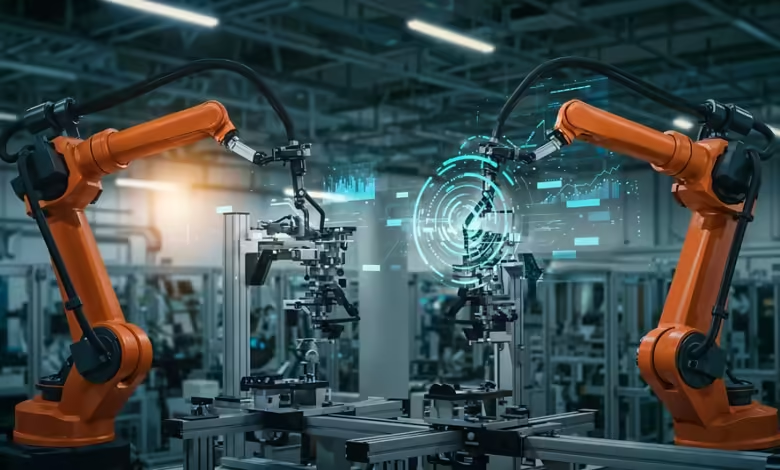
Vision control systems offer a solution by automating inspection tasks that previously required human judgment. These systems can detect defects, verify assembly completeness, and measure dimensional accuracy at production speeds far exceeding manual capabilities. However, the financial commitment required for implementation varies dramatically based on application complexity, integration requirements, and operational scope. Understanding how investment levels correlate with expected returns helps manufacturing decision-makers develop realistic project budgets and performance expectations.
Understanding Investment Tiers in Automated Vision Systems
Vision control system integration projects typically fall into distinct investment categories, each addressing different operational challenges and complexity levels. The $50,000 entry tier generally covers single-station applications with straightforward pass/fail inspection criteria. These systems handle basic dimensional checking, presence verification, or simple surface defect detection on standard production lines. A comprehensive Vision Control System Integration overview reveals that mid-tier investments ranging from $150,000 to $250,000 support multi-station deployments with advanced measurement capabilities, color analysis, or optical character recognition functions.
The upper investment tier, extending to $500,000 and beyond, encompasses complex multi-camera systems with sophisticated image processing algorithms, extensive database integration, and comprehensive reporting capabilities. These installations often include custom lighting solutions, specialized optics for challenging inspection environments, and integration with existing manufacturing execution systems. The cost escalation reflects not just hardware complexity but also engineering time for custom algorithm development, system calibration, and operator training requirements.
Investment scaling follows operational complexity rather than linear progression. A facility inspecting simple components for dimensional conformance requires significantly less sophisticated vision processing than one performing surface texture analysis or multi-angle defect detection. The difference in system capability and associated costs reflects the computational requirements, optical precision, and integration complexity needed to achieve reliable performance in each application.
Hardware Components Driving Cost Variation
Camera resolution and frame rate capabilities represent primary cost drivers in vision system implementations. Basic applications utilizing standard industrial cameras with adequate lighting can achieve reliable inspection results at lower investment levels. However, applications requiring high-speed capture, extreme magnification, or specialized spectral analysis demand more sophisticated imaging hardware with correspondingly higher costs.
Lighting systems contribute significantly to overall project costs, particularly in challenging inspection environments. Simple applications may function adequately with standard LED illumination, while complex surface inspections often require structured lighting, polarized illumination, or multi-angle lighting arrays to achieve consistent results. The lighting design directly impacts image quality and system reliability, making it a critical investment area for demanding applications.
Processing hardware requirements scale dramatically with image analysis complexity. Basic dimensional measurements and presence detection can operate effectively on standard industrial computers, while advanced defect classification, pattern recognition, or real-time statistical analysis may require specialized processing units or distributed computing architectures to maintain production speeds.
Software and Algorithm Development Considerations
Standard vision libraries and pre-configured inspection tools support many common applications at relatively modest development costs. These solutions work effectively for dimensional measurement, barcode reading, and basic defect detection tasks. However, custom applications requiring specialized algorithms, machine learning integration, or complex decision trees necessitate significant software development investment.
Algorithm training and optimization represent ongoing costs that extend beyond initial implementation. Systems performing defect classification or quality grading require extensive sample libraries and iterative refinement to achieve acceptable accuracy rates. The development timeline for these advanced capabilities often extends project duration and increases overall investment requirements.
Integration with existing manufacturing systems adds complexity and cost to vision implementations. Simple standalone systems require minimal integration effort, while installations connecting to enterprise resource planning systems, statistical process control databases, or automated material handling equipment demand substantial programming and testing investment.
ROI Calculation Methodologies for Vision Integration
Return on investment calculations for vision control systems must account for both direct cost savings and indirect operational benefits. Direct savings typically include labor cost reduction from eliminated inspection positions, reduced scrap costs through improved defect detection, and decreased rework expenses from catching problems earlier in the production process. These quantifiable benefits form the foundation of most ROI analyses and provide clear metrics for project justification.
Indirect benefits often exceed direct savings but require more sophisticated measurement approaches. Improved product consistency leads to reduced customer complaints, lower warranty costs, and enhanced brand reputation. According to the National Institute of Standards and Technology, poor quality costs manufacturers between 10 to 15 percent of their total revenue, making quality improvements a significant value driver beyond immediate cost savings.
Capacity improvements represent another substantial ROI component. Vision systems typically inspect products faster than manual methods while maintaining consistent accuracy levels. This speed advantage can increase effective production capacity without additional labor or equipment investment. For facilities operating near capacity limits, this throughput improvement may enable revenue growth without facility expansion.
Labor Cost Impact Analysis
Direct labor savings calculations must consider fully loaded employment costs, including wages, benefits, training, and turnover expenses. Vision systems eliminate inspection labor costs while requiring minimal ongoing operator intervention. However, the analysis should account for maintenance requirements, system monitoring duties, and periodic calibration tasks that represent ongoing labor commitments.
Indirect labor impacts often provide additional savings through reduced supervision requirements, elimination of inspection bottlenecks, and decreased quality dispute resolution time. Manufacturing facilities frequently discover that automated inspection systems reduce management overhead and allow quality personnel to focus on process improvement rather than routine inspection tasks.
Training cost reductions represent an often-overlooked benefit category. Manual inspection methods require extensive operator training to achieve consistent results, along with ongoing refresher training and quality audits. Vision systems maintain consistent performance standards without the variability introduced by human factors, reducing training requirements and associated costs.
Quality Cost Reduction Opportunities
Scrap reduction typically provides the most measurable quality-related savings from vision system implementation. Automated inspection systems detect defects more consistently than manual methods, reducing both false accepts and false rejects. The cost savings from eliminated scrap often justify significant portions of the system investment, particularly in high-value manufacturing applications.
Rework cost elimination represents another substantial savings category. Vision systems identify problems immediately upon occurrence, allowing immediate correction rather than downstream discovery of defects. This early detection prevents value-added processing of defective parts and reduces the total cost impact of quality problems.
Customer quality costs, including returns, warranty claims, and relationship damage, represent the highest-value savings category but require longer-term measurement to quantify accurately. Improved outgoing quality leads to reduced field failures, lower warranty expenses, and improved customer satisfaction scores that translate to increased sales and market share over time.
Investment Scaling Strategies by Production Volume
Production volume directly influences optimal investment levels and expected payback periods for vision control system integration projects. High-volume operations can justify sophisticated systems through accumulated savings across large quantities of inspected products. The fixed cost of system implementation spreads across thousands or millions of parts, making even expensive installations economically viable when quality improvements and labor savings are calculated per unit.
Low-volume, high-value production environments often benefit from vision systems despite limited quantity throughput. The cost of quality problems in aerospace, medical device, or precision electronics manufacturing can exceed the entire system investment with a single defect escape. These applications justify advanced vision capabilities based on risk avoidance rather than volume-based savings calculations.
Medium-volume operations require careful analysis to optimize investment levels with operational benefits. These facilities often benefit from modular system designs that allow capability expansion as production volumes grow. Starting with basic inspection functions and adding advanced features over time spreads investment costs while providing immediate operational benefits.
Batch vs. Continuous Production Considerations
Continuous production environments typically achieve faster payback periods from vision system investments due to consistent utilization rates. Systems operating multiple shifts per day generate savings continuously, maximizing return on invested capital. The consistent operating environment also simplifies system design and reduces complexity compared to frequently changing batch operations.
Batch production operations require more flexible vision system designs to accommodate product changeovers and varying inspection requirements. While this flexibility increases initial investment costs, it enables single systems to serve multiple product lines and optimize equipment utilization. The ROI calculation must account for setup time requirements and changeover complexity when evaluating system benefits.
Mixed production environments benefit from vision systems that balance flexibility with performance optimization. These implementations often utilize modular hardware designs with software-driven inspection parameter changes to accommodate different products without extensive physical reconfiguration.
Market Timing and Competitive Advantage
Early adoption of vision control system integration can provide competitive advantages that extend beyond immediate cost savings. Facilities implementing advanced quality control capabilities often achieve preferred supplier status with customers seeking reliable partners for critical applications. This market positioning can lead to increased business volume and premium pricing opportunities that significantly enhance ROI calculations.
Industry requirements for quality documentation and traceability continue expanding, making automated inspection systems increasingly necessary for regulatory compliance. Facilities implementing vision systems proactively avoid rushed installations required for compliance deadlines and benefit from optimized system designs rather than expedited solutions.
Technology advancement rates in vision systems favor current implementations over delayed decisions. Modern systems offer improved performance and lower costs compared to older generations, while integration complexity continues decreasing through standardized interfaces and improved software tools.
Risk Assessment and Mitigation Factors
Technical risk evaluation forms a critical component of vision system ROI analysis, as system failures can impact production capacity and quality performance simultaneously. Reliable system design requires redundancy planning, maintenance protocols, and backup procedures to ensure consistent operation. The cost of these reliability measures must be balanced against potential production losses from system downtime.
Application suitability represents the primary technical risk factor in vision system implementations. Some inspection tasks challenge current vision technology capabilities or require environmental modifications to achieve reliable results. Thorough feasibility testing during the design phase reduces implementation risks but adds to project timelines and costs.
Integration complexity with existing manufacturing systems creates additional risk factors that can impact project success and ultimate ROI achievement. Compatibility issues, communication protocols, and software integration challenges may require additional development effort and delay project completion. These risks increase with system complexity and integration scope.
Performance Validation and Acceptance Criteria
Establishing clear performance metrics and acceptance criteria before system implementation ensures that ROI expectations align with delivered capabilities. These specifications should address accuracy requirements, throughput targets, and reliability standards that support the business case calculations. Detailed acceptance testing validates that installed systems meet performance expectations before final acceptance.
Ongoing performance monitoring ensures that vision systems continue delivering expected benefits throughout their operational life. Regular calibration schedules, performance audits, and maintenance protocols maintain system accuracy and reliability. The cost of these ongoing requirements should be factored into total cost of ownership calculations.
Continuous improvement opportunities often emerge after initial system implementation, as operators identify additional applications or optimization possibilities. Planning for future enhancements during initial system design can reduce upgrade costs and maximize long-term ROI from vision system investments.
Maintenance and Lifecycle Cost Planning
Preventive maintenance requirements for vision systems include regular cleaning of optical components, calibration verification, and software updates to maintain optimal performance. These routine tasks require minimal time investment but significantly impact system reliability and accuracy over time. Neglecting maintenance protocols can lead to gradual performance degradation that erodes ROI benefits.
Component replacement planning should address camera life expectancy, lighting system degradation, and computing hardware obsolescence. Vision system components typically provide several years of reliable service, but planning for eventual replacement ensures uninterrupted operation and maintained performance levels.
Technology refresh cycles in vision systems generally extend longer than typical industrial automation equipment due to robust hardware designs and software backward compatibility. However, periodic upgrades may provide enhanced capabilities or improved performance that justify reinvestment for continued competitive advantage.
Implementation Timeline and Cash Flow Considerations
Vision system implementation timelines directly impact ROI calculations through delayed benefit realization and ongoing operational costs during installation periods. Complex systems requiring extensive custom development or facility modifications may require several months between project initiation and full operational status. The timeline must account for equipment procurement, software development, installation, testing, and operator training phases.
Cash flow planning for vision system projects should consider payment schedules, implementation milestones, and benefit realization timing. Front-loaded equipment costs contrast with ongoing benefit accumulation, creating negative cash flow during implementation periods. Understanding this timing helps establish realistic payback expectations and financial planning requirements.
Phased implementation approaches can improve cash flow profiles by delivering partial benefits during installation of complete systems. Starting with single stations or basic inspection functions while developing advanced capabilities allows immediate ROI generation to offset ongoing development costs.
Training and Transition Management
Operator training requirements vary significantly based on system complexity and existing workforce capabilities. Basic vision systems may require minimal training for routine operation, while advanced systems with extensive parameter adjustment capabilities demand more comprehensive training programs. Training costs should include both initial instruction and ongoing education for new employees.
Transition planning from manual to automated inspection methods requires careful coordination to maintain production continuity during implementation. Parallel operation periods allow system validation while maintaining backup inspection capabilities, but double the inspection labor costs during transition periods.
Change management considerations address workforce concerns about automation implementation and job security issues. Successful transitions often involve redeploying affected personnel to higher-value activities rather than eliminating positions, maintaining workforce morale while achieving operational improvements.
Conclusion
Vision control system integration represents a scalable investment opportunity with ROI potential that correlates directly with application complexity and operational requirements. Entry-level systems at $50,000 investment levels provide solid returns through basic labor savings and quality improvements, while advanced installations reaching $500,000 deliver comprehensive automation benefits including enhanced capacity, reduced risk exposure, and competitive differentiation.
Successful ROI achievement requires careful alignment between investment levels and operational needs, realistic performance expectations, and comprehensive cost-benefit analysis that includes both direct savings and indirect operational improvements. The framework presented demonstrates that vision system integration can deliver measurable returns across diverse investment levels when properly matched to application requirements and operational objectives.
Manufacturing facilities considering vision system implementation should focus on thorough application analysis, realistic timeline planning, and comprehensive total cost of ownership calculations that account for ongoing operational requirements. The technology maturity and proven track record of vision systems in industrial applications make them a reliable investment for facilities seeking to improve quality performance while reducing operational costs.